


Qaitbay Citadel Alexandria Egypt: Complete History, Tickets & Visitor Guide (2025/2026)
Ticket (Foreigner)
200 EGP
~$4 USD
Opening Hours
9 AM – 5 PM
7 PM in summer
Built
1477 AD
Sultan Qaitbay
Location
Eastern Harbour
Mediterranean coast
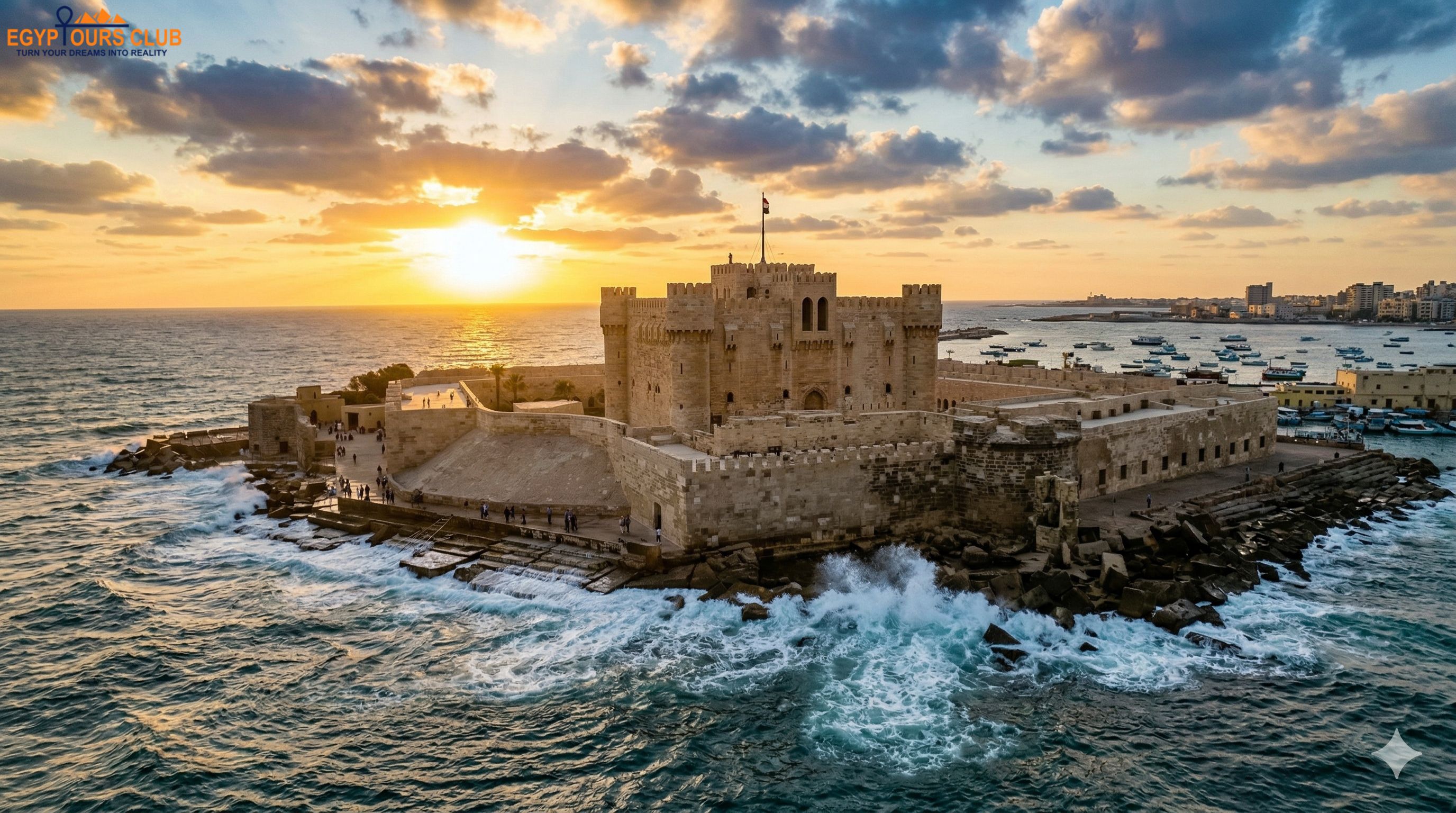
The Qaitbay Citadel in Alexandria, Egypt is one of the most historically significant — and visually spectacular — landmarks on the entire Mediterranean coast. Standing at the very tip of Alexandria's Eastern Harbour, this 15th-century Mamluk fortress rises from the sea on the exact spot where the ancient Lighthouse of Alexandria once guided ships across the Mediterranean — one of the original Seven Wonders of the Ancient World.
For any traveller visiting Egypt, the Citadel of Qaitbay represents something genuinely rare: a place where the ancient and medieval worlds collide in a single, breathtaking location. Whether you are planning an Alexandria day tour from Cairo, a multi-day Egypt itinerary, or a dedicated coastal visit, the Qaitbay Citadel is an unmissable landmark that rewards every visitor with sweeping sea views, centuries of history, and one of Egypt's most photogenic sunsets.
History of Qaitbay Citadel: From Ancient Wonder to Medieval Fortress
The Ancient Lighthouse of Alexandria (280 BC – 14th Century AD)
To understand the Qaitbay Citadel fully, you must first understand what stood here before it. In approximately 280 BC, under the reign of Ptolemy II Philadelphus, the Pharos Lighthouse of Alexandria was completed on the small island of Pharos at the entrance to Alexandria's harbour. Standing between 100 and 130 metres tall — the equivalent of a 40-storey building — the Pharos was the tallest man-made structure in the ancient world after the pyramids. So famous was it that the word "pharos" became the root of the word for lighthouse in French (phare), Italian (faro), and Spanish (faro).
The lighthouse guided ships safely into Alexandria's harbour for nearly 1,600 years. However, a series of devastating earthquakes between the 10th and 14th centuries gradually brought the structure down. By 1323 AD, Arab traveller Ibn Battuta described it as already in ruins. The final collapse is believed to have occurred by the late 14th century, leaving only the foundation stones on the Pharos peninsula — the very stones on which Sultan Qaitbay would build his citadel.
Who Built Qaitbay Citadel? (1477–1479 AD)
The Citadel of Qaitbay was commissioned by the Mamluk Sultan Al-Ashraf Sayf al-Din Qa'it Bay, one of the longest-reigning and most accomplished sultans of the Mamluk Sultanate. Construction began in 1477 AD and was completed in just two years by 1479 AD. The architect responsible for the design was Qagmas Al-Eshaqy, the palace mason of the Mamluk court.
Sultan Qaitbay's motivation was strategic: the growing power of the Ottoman Empire in the eastern Mediterranean posed a direct naval threat to Egypt's northern coast. The sultan had already constructed or reinforced fortifications across the Levant and Egypt. The Alexandria citadel — built from the limestone blocks of the collapsed lighthouse and positioned to command both the Eastern and Western harbours — was his most ambitious coastal defence. Spanning an area of approximately 17,550 square metres, the fortress was designed to house artillery, garrison troops, and store military provisions.
Later History: Ottoman, French & British Periods
After the Ottoman conquest of Egypt in 1517, the Qaitbay Citadel fell into gradual neglect. It was partially used during Napoleon Bonaparte's Egyptian campaign of 1798–1801, and in 1882, British naval bombardment during the Egyptian national uprising caused significant damage to the structure. Following independence, major restoration campaigns were undertaken, and in 1952 the citadel was converted into a naval museum — the role it still serves today as both a heritage site and the home of Egypt's Naval Museum.
🏛️ Combine the Qaitbay Citadel with Alexandria's other great landmarks — the Catacombs of Kom El Shoqafa, Pompey's Pillar, and the Bibliotheca Alexandrina — on our 4-Day Cairo & Alexandria Tour, fully guided by a licensed Egyptologist.
Architecture & Design of the Qaitbay Citadel
The Qaitbay Citadel architecture is a masterpiece of Mamluk military engineering, incorporating recycled limestone blocks from the ancient lighthouse alongside freshly quarried stone. The fortress covers a compact but formidable footprint, enclosed by two concentric defensive walls studded with semi-circular towers.
The Main Tower
The centrepiece of the citadel is its massive main tower, located in the northwest corner of the inner courtyard. This square fort measures approximately 30 metres per side and stands 17 metres tall across three floors. Each corner of the tower is flanked by a semi-circular tower that terminates in a projecting balcony — these corbelled machicolations allowed defenders to fire arrows or drop objects on attackers from two separate levels without exposing themselves to return fire. The main tower's ground floor contains vaulted storage rooms; the upper floors house the mosque, cisterns, and residential quarters for the sultan's garrison.
The Mosque Within the Citadel
One of the Qaitbay Citadel's most surprising and beautiful features is the small but exquisite mosque built inside the main tower. This mosque — reportedly the oldest in Alexandria — served the fortress's garrison and features fine Mamluk stonework, geometric lattice windows, and a delicate marble mihrab (prayer niche) pointing toward Mecca. It remains intact to this day and is one of the hidden highlights of any visit.
The Water Cistern
A large underground cistern adjacent to the main tower supplied the garrison's soldiers and their horses with fresh water — a critical military feature for a coastal fortress that could be besieged from the sea. The cistern's engineering reflects the sophistication of Mamluk hydraulic planning.
Qaitbay Citadel Tickets, Opening Hours & Practical Information (2025)
Ticket Prices
| Visitor Category | Ticket Price | Notes |
|---|---|---|
| Foreign adults | 200 EGP (~$4 USD) | Standard entry to fortress & museum |
| Foreign students | 100 EGP (~$2 USD) | Valid student ID required; max age 24 |
| Egyptian adults | 20 EGP | National ID required |
| Egyptian students | 5 EGP | Valid student ID required |
| Children under 6 | Free | No ticket required |
| Egyptians aged 60+ | Free | National ID required |
| Egyptians with special needs | Free | Documentation required |
| Mobile photography | Free | Professional camera equipment: ask on-site |
Opening Hours
| Season | Opening Time | Last Entry | Closing Time |
|---|---|---|---|
| Winter (Oct–Apr) | 9:00 AM | 4:00 PM | 5:00 PM |
| Summer (May–Sep) | 9:00 AM | 6:00 PM | 7:00 PM |
* The citadel is open seven days a week. Arrive at least one hour before closing time. Hours are subject to change on Egyptian public holidays — verify with Egypt Tours Club before visiting.
How to Get There
| From | Method | Duration | Notes |
|---|---|---|---|
| Cairo | Private car with tour guide | ~2.5–3 hours | Most comfortable; includes hotel pick-up |
| Cairo | Train (Ramses → Misr Station) | ~2–2.5 hours | AC train available; then taxi from station |
| Alexandria Ramla Square | Walk along the Corniche | 30–45 minutes | Scenic coastal route recommended at sunset |
| Alexandria city centre | Taxi / Uber | 10–15 minutes | Most convenient; fixed fare approx. 30–50 EGP |
| Address | El-Gaish Road, As Sayalah Sharq, Al Gomrok, Alexandria 5321380 | ||
What to See & Do at Qaitbay Citadel
A visit to the Qaitbay Citadel rewards careful exploration. Rather than simply photographing the exterior and leaving, allow 1.5–2 hours to experience the full range of what this remarkable fortress contains:
- The Main Tower (Three Floors). Work your way up through the three floors of the central keep, exploring vaulted chambers, narrow stairways, and the projecting corner towers. The views from the upper level ramparts over Alexandria's harbour are extraordinary — the best in the city.
- The Mosque of Sultan Qaitbay. Don't miss the small but exquisite mosque inside the main tower — one of the oldest in Alexandria, with intact Mamluk geometric decorations and a beautiful marble mihrab. Few visitors realise it is here.
- The Naval Museum. The citadel houses a small but interesting Naval Museum with exhibits of model ships, ancient anchors, maritime instruments, and documents relating to Egypt's naval history. The adjacent aquarium (separate entrance) displays fossilised marine animals and regional marine life.
- The Ramparts & Sea Walk. Walk the outer walls and look north across the open Mediterranean. On a clear day the views are extraordinary — and the stone beneath your feet is in part the same limestone that once formed the ancient lighthouse.
- Sunset Photography. The Qaitbay Citadel is one of Egypt's finest sunset locations. The fortress glows golden in the last hour of daylight, and the fishing boats of the Eastern Harbour create a timeless foreground for photographs. Arrive one hour before closing for the best light.
- The Harbour Promenade. The area surrounding the citadel is lively and atmospheric — local vendors, shell jewellery stalls, and fresh seafood restaurants line the harbour walk. Allow extra time to absorb the atmosphere after your visit.
🚌 Visiting the Red Sea coast? Egypt Tours Club also operates Egypt tour packages that combine Alexandria with Cairo and a Nile cruise — the perfect way to experience the full breadth of Egypt in one seamless journey.
Best Time to Visit Qaitbay Citadel & Insider Tips
When to Visit Alexandria
Alexandria is a year-round destination, but the best months for a comfortable and rewarding visit are October through April, when temperatures on the Mediterranean coast are pleasantly mild (18–26°C). The summer months (June–August) are warm but not as intense as Cairo, and the sea breeze makes the citadel area particularly pleasant for an evening visit during extended summer hours.
The best time of day to visit Qaitbay Citadel is late afternoon — arriving around 3:00 PM allows you to explore the fortress in detail before positioning yourself on the ramparts for the sunset over the Mediterranean, widely regarded as one of Egypt's most beautiful natural spectacles.
| Season | Temperature | Crowds | Recommendation |
|---|---|---|---|
| Oct – Nov | 22–28°C | Moderate | ✅ Excellent — warm, comfortable, fewer crowds |
| Dec – Feb | 14–20°C | Low | ✅ Good — cool, quiet, ideal for photography |
| Mar – Apr | 18–26°C | Moderate | ✅ Great — spring light perfect for photos |
| May – Sep | 26–32°C | Lower (weekdays) | ⚠️ Hot midday — visit in the evening (open until 7 PM) |
Frequently Asked Questions about Qaitbay Citadel
How much are Qaitbay Citadel tickets in 2025?
Foreign visitors pay 200 Egyptian Pounds (approximately $4 USD) for standard entry. Foreign students with a valid ID pay 100 EGP. Egyptian nationals pay 20 EGP. Children under 6, Egyptians over 60, and Egyptians with special needs enter free. Mobile photography is free of charge. Tickets are purchased at the entrance — no advance online booking is currently required for individual visitors.
What are the opening hours of Qaitbay Citadel?
The citadel is open daily from 9:00 AM. In winter (October–April) it closes at 5:00 PM, with last entry at 4:00 PM. In summer (May–September) it stays open until 7:00 PM, with last entry at 6:00 PM. The citadel is open seven days a week including Fridays and public holidays.
Can I visit Qaitbay Citadel as a day trip from Cairo?
Yes — absolutely. Alexandria is approximately 2.5–3 hours from Cairo by car or express train. Egypt Tours Club offers Cairo and Alexandria tour packages that include Qaitbay Citadel alongside the Catacombs of Kom El Shoqafa, Pompey's Pillar, and the Bibliotheca Alexandrina, all guided by a private Egyptologist with hotel pick-up from Cairo.
Is Qaitbay Citadel wheelchair accessible?
Partial accessibility only. The outer grounds and courtyard are generally accessible, but the interior of the main tower involves stairs and uneven stone surfaces that are not fully wheelchair accessible. The ground-floor areas and exterior ramparts offer significant historical and scenic value without needing to navigate the upper levels.
How long does a visit to Qaitbay Citadel take?
Allow 1 to 2 hours for a thorough visit including the main tower (three floors), the interior mosque, the Naval Museum, and the outer ramparts. If you plan to enjoy the sunset from the walls or walk the surrounding harbour promenade, budget an additional 30–60 minutes.
What else is near Qaitbay Citadel in Alexandria?
Within Alexandria, the key attractions to combine with a Qaitbay visit include the Catacombs of Kom El Shoqafa (2nd-century Greco-Roman burial complex, approximately 20 minutes by taxi), Pompey's Pillar (a 25-metre Roman column from 297 AD, near the catacombs), the Bibliotheca Alexandrina (the modern revival of the ancient library, on the Corniche), and the Roman Amphitheatre (Kom el-Dikka, 2nd–3rd century AD). All of these can be combined in one full-day Alexandria itinerary — see our 5-Day Cairo and Alexandria tour.
Is there parking at Qaitbay Citadel?
There is limited street parking near the citadel along El-Gaish Road. For visitors arriving by private tour vehicle, your driver will drop you at the entrance and wait nearby. If arriving independently by taxi or Uber, you can be dropped directly at the entrance gate on the harbour road.
Ready to Visit Qaitbay Citadel?
Book your private Alexandria day tour or Cairo & Alexandria tour package with Egypt Tours Club. Egyptologist guide, private transport & hotel pick-up included.
Book 4-Day Cairo & Alexandria → View 5-Day Egypt Short BreakOther Top Attractions in Alexandria & Egypt
After your visit to Qaitbay Citadel, continue exploring Egypt's extraordinary heritage with Egypt Tours Club:
- All Top Attractions in Egypt — Complete guide to Egypt's most iconic landmarks from the Pyramids of Giza to the temples of Luxor.
- 8-Day Egypt Tour with Nile Cruise — Combine Cairo, Alexandria, and a luxury Nile cruise from Aswan to Luxor in one unforgettable journey.
- Top Cities in Egypt — Explore Cairo, Luxor, Aswan, Alexandria, Hurghada, and Sharm El Sheikh with Egypt Tours Club.
- 15-Day Egypt Discovery Tour — The ultimate Egypt journey: Cairo, Alexandria, Nile Cruise, Luxor, Aswan, Sharm El Sheikh & the White Desert.
- Tailor-Made Egypt Tours — Build a fully bespoke Egypt itinerary around your travel dates, interests, and pace.
Qaitbay Citadel: Key Facts at a Glance
| Fact | Details |
|---|---|
| Official Name | Citadel of Qaitbay (قلعة قايتباي) |
| Built | 1477–1479 AD (882–884 AH) |
| Builder | Sultan Al-Ashraf Sayf al-Din Qa'it Bay |
| Architect | Qagmas Al-Eshaqy (Palace Mason) |
| Style | Mamluk military architecture; limestone construction |
| Site | Built on ruins of the Lighthouse of Alexandria (280 BC) |
| Total Area | ~17,550 m² |
| Main Tower | 3 floors; 30m × 30m; 17m tall; four semi-circular corner towers |
| Current Function | Heritage site, Naval Museum, cultural venue |
| Nearest Landmark | Bibliotheca Alexandrina (4.5 km), Catacombs of Kom El Shoqafa (6 km) |
| UNESCO Status | Part of broader Alexandria heritage (not individually listed) |
| TripAdvisor Ranking | #1 attraction in Alexandria |
Sources & References
- Egyptian Ministry of Tourism & Antiquities — Qaitbay Fort Official Record
- Egypt Monuments Official Booking Portal — Tickets & Opening Hours
- TripAdvisor — Citadel of Qaitbay Reviews
- Egypt Tours Club — 4-Day Cairo & Alexandria Package
- Egypt Tours Club — 5-Day Egypt Short Break
- Audiala — Citadel of Qaitbay Visitor Guide 2025
- Egypt United Tours — Citadel of Qaitbay Historical Detail
Content last updated: April 2026 | Egypt Tours Club — egypttoursclub.com
Internal links: 10 | Schema: TouristAttraction + FAQPage + BreadcrumbList | Target keywords: Qaitbay Citadel Alexandria Egypt, Qaitbay Citadel tickets, Alexandria day tour, Lighthouse of Alexandria